More requests than existing planning tools could study
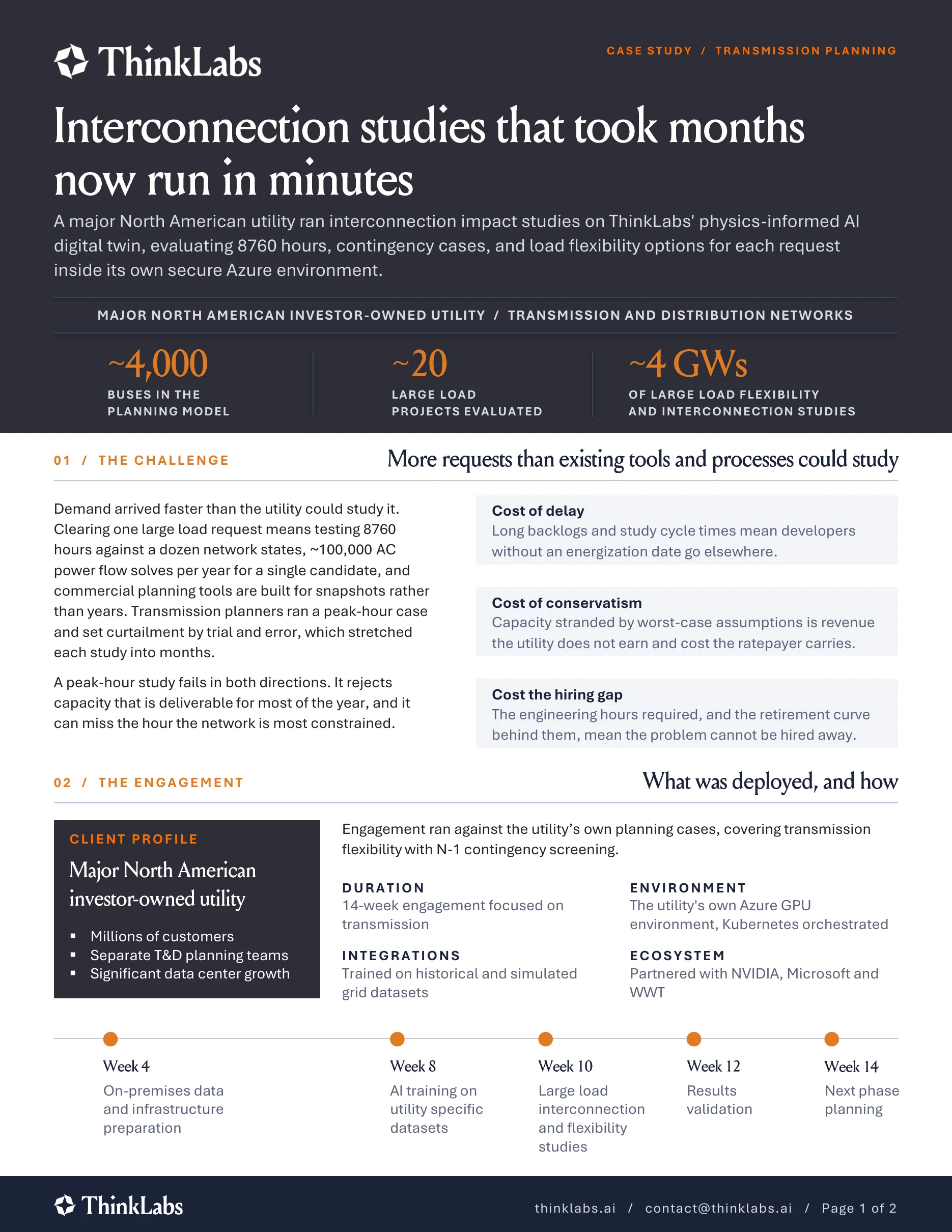
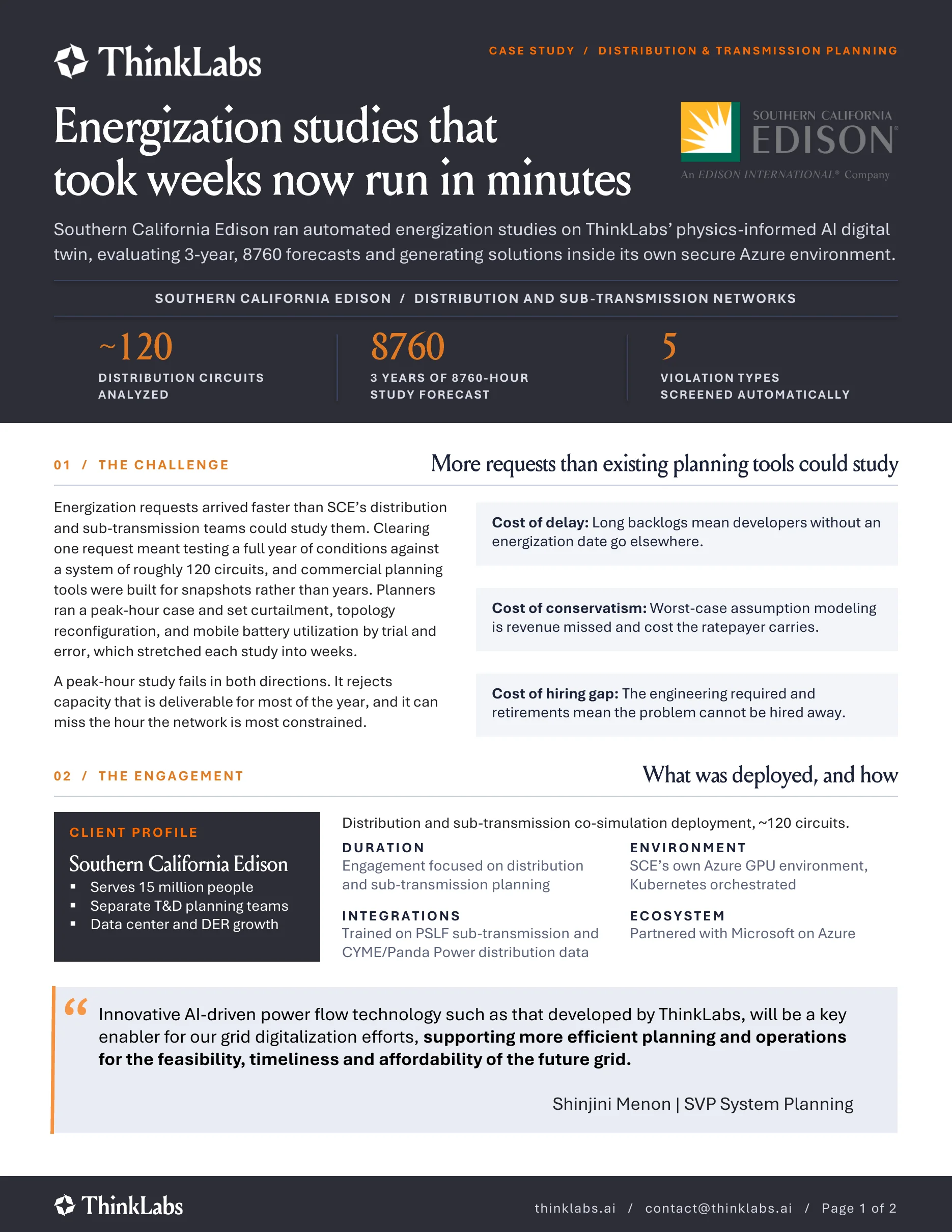
Energization requests arrived faster than SCE’s distribution and sub-transmission teams could study them. Clearing one request meant testing a full year of conditions against a system of roughly 120 circuits, and commercial planning tools were built for snapshots rather than years. Planners ran a peak-hour case and set curtailment, topology reconfiguration, and mobile battery utilization by trial and error, which stretched each study into weeks.
A peak-hour study fails in both directions. It rejects capacity that is deliverable for most of the year, and it can miss the hour the network is most constrained.
- Cost of delayLong backlogs mean developers without an energization date go elsewhere.
- Cost of conservatismWorst-case assumption modeling is revenue missed and cost the ratepayer carries.
- Cost of hiring gapThe engineering required and retirements mean the problem cannot be hired away.
What was deployed, and how
Distribution and sub-transmission co-simulation deployment, ~120 circuits.
Client profile
- Serves 15 million people
- Separate T&D planning teams
- Data center and DER growth
Innovative AI-driven power flow technology such as that developed by ThinkLabs, will be a key enabler for our grid digitalization efforts,supporting more efficient planning and operations for the feasibility, timeliness and affordability of the future grid.
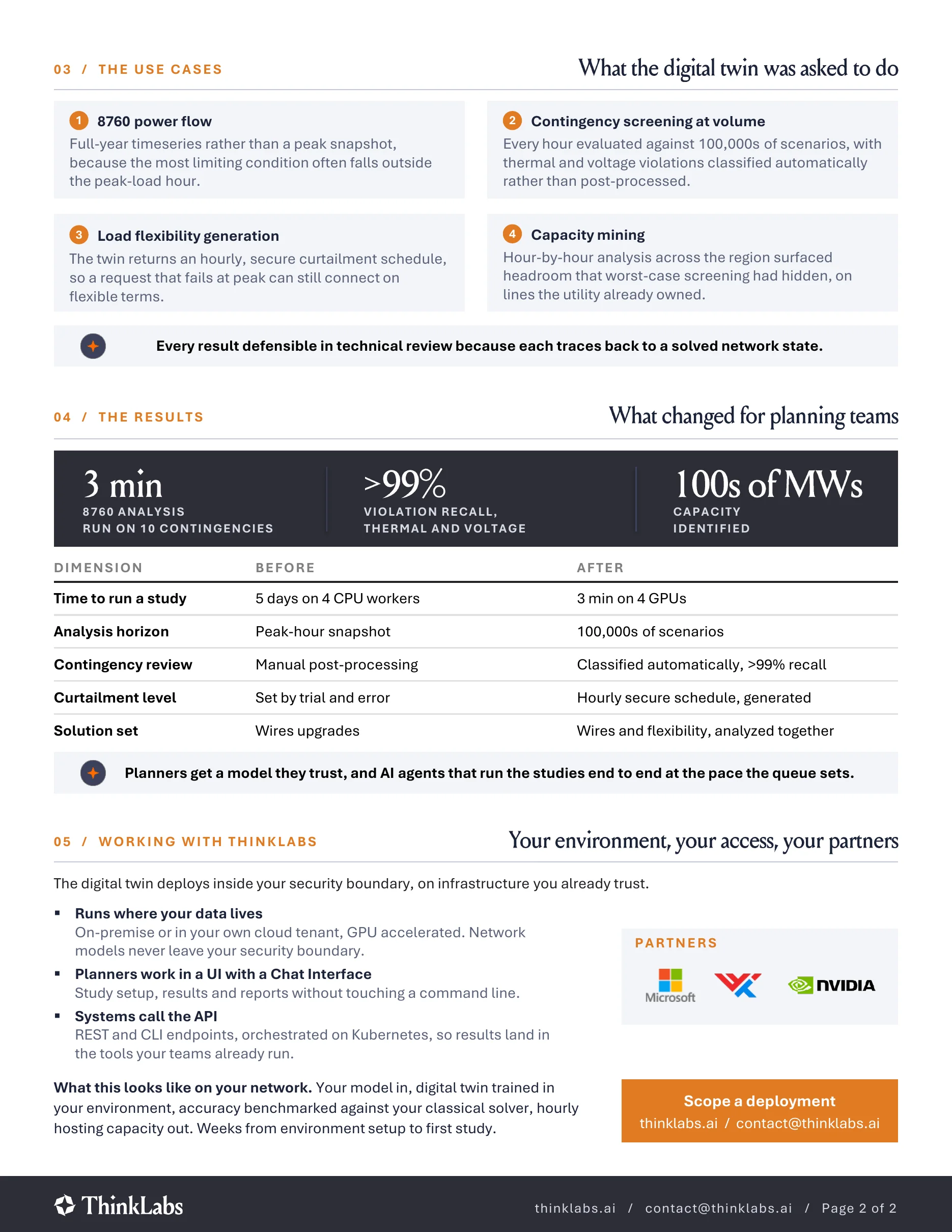
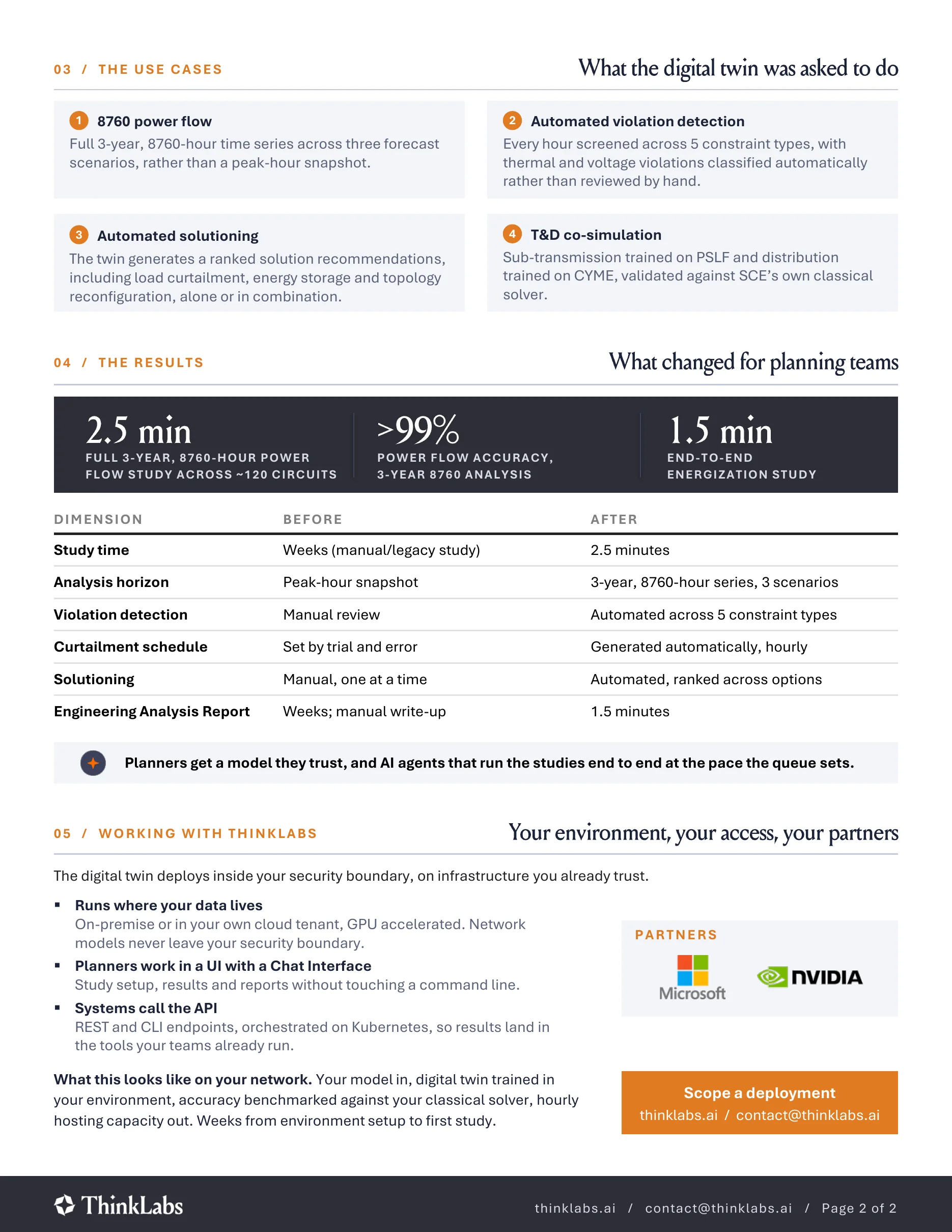
What the digital twin was asked to do
8760 power flow
Full 3-year, 8760-hour time series across three forecast scenarios, rather than a peak-hour snapshot.Automated violation detection
Every hour screened across 5 constraint types, with thermal and voltage violations classified automatically rather than reviewed by hand.Automated solutioning
The twin generates ranked solution recommendations, including load curtailment, energy storage and topology reconfiguration, alone or in combination.T&D co-simulation
Sub-transmission trained on PSLF and distribution trained on CYME, validated against SCE’s own classical solver.
What changed for planning teams
Planners get a model they trust, and AI agents that run the studies end to end at the pace the queue sets.
Your environment, your access, your partners
The digital twin deploys inside your security boundary, on infrastructure you already trust.
Runs where your data lives
On-premise or in your own cloud tenant, GPU accelerated. Network models never leave your security boundary.
Planners work in a UI with a Chat Interface
Study setup, results and reports without touching a command line.
Systems call the API
REST and CLI endpoints, orchestrated on Kubernetes, so results land in the tools your teams already run.
Partners


What this looks like on your network. Your model in, digital twin trained in your environment, accuracy benchmarked against your classical solver, hourly hosting capacity out. Weeks from environment setup to first study.
Scope a deployment