
Capacity you already have. Answers you can defend.
Physics-informed AI that trains from your transmission network, locates the headroom already on your system, and runs a full interconnection assessment in minutes, surfacing every constraint, proposing defensible strategies, and valuing what customers bring to turn a ‘no’ into a ‘yes’.

Full-year analysis. Results in minutes.
Large load is arriving faster than steel can be built.
Data centers, electrification, and reshoring are pushing gigawatts into queues built for annual study cycles, and each request consumes months of manual study by planners nobody can hire fast enough. Much of the capacity to serve that load is already on the system. Some of it arrives with the customer.
Most tools tell you where an interconnect request breaks. ThinkLabs tells you how to fix it.
ThinkLabs runs at the speed and scale of multi-year time series scenarios, secured in your environment, and validated against the solver you already run, so every result is verified. It generates solutions to what your network can carry, connects load on terms you can defend, and builds only what is genuinely left.
One digital twin, built for the utility. Trusted by everyone that touches the transmission network.

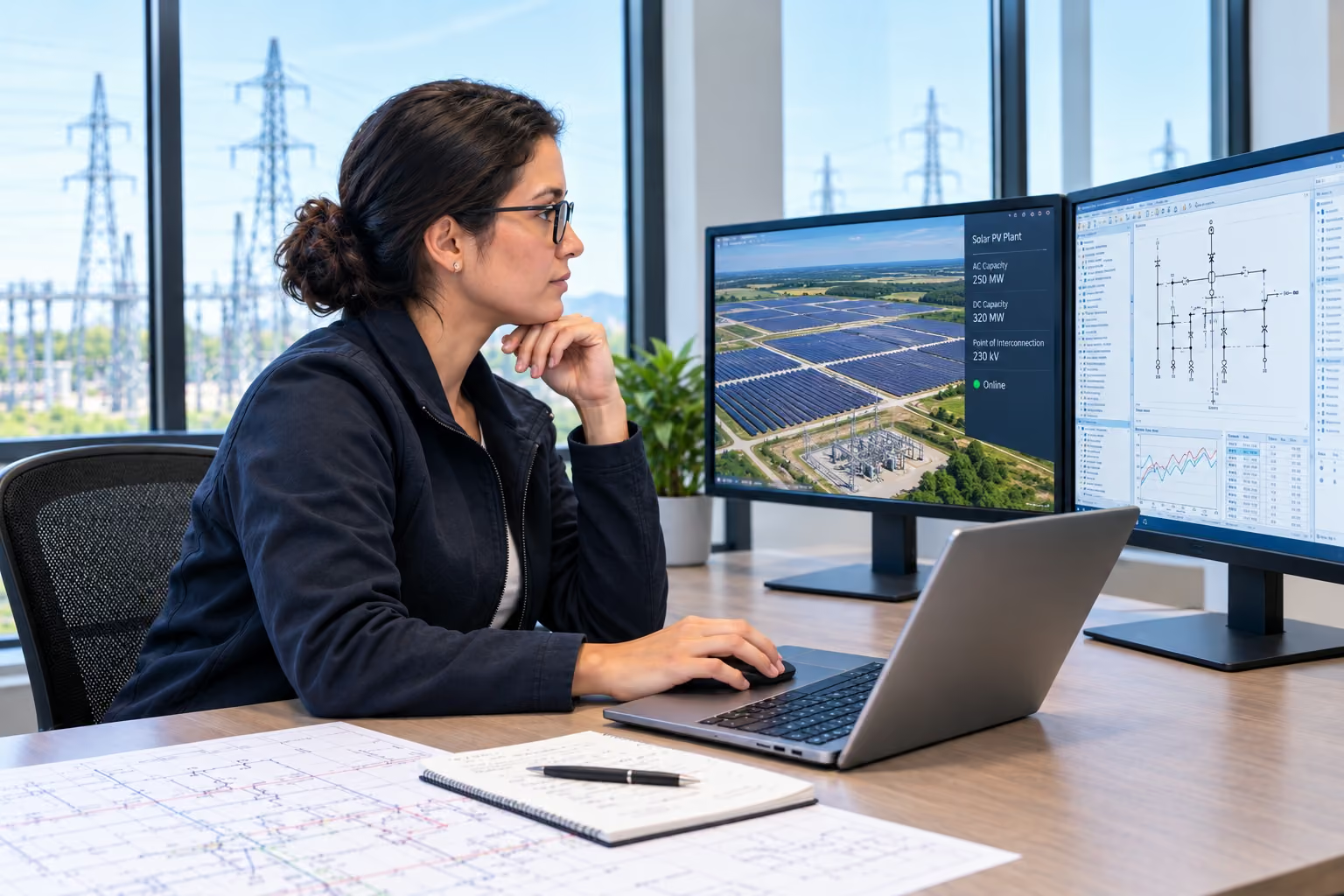
Transmission planning engineers
Clear more requests per week, with a full year of network states behind each study instead of a peak-hour approximation.
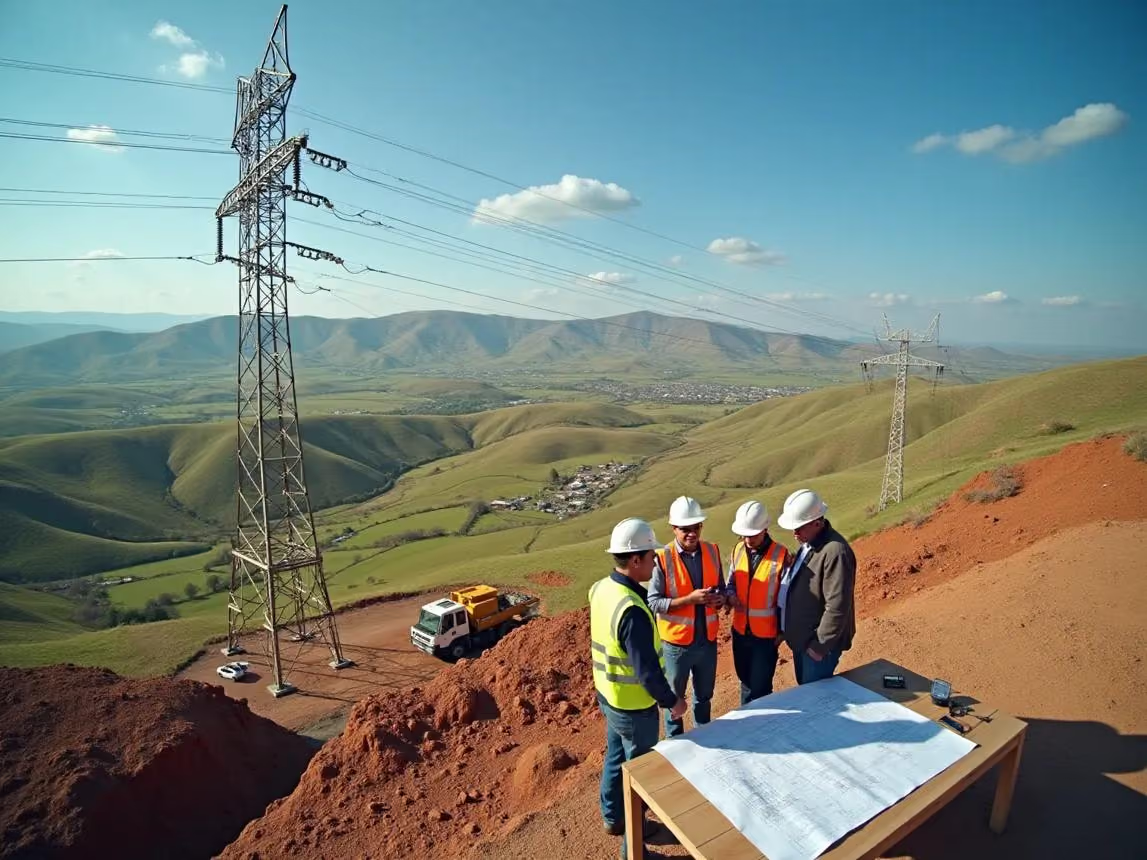
Interconnection engineers
Name the constraint that sets the limit, down to the bus and the hour, in the same sitting the request comes in.

Commercial business development
Get a capacity and timeline answer for large load customers that values what capacity and generation they bring, before they take the load elsewhere.
Competitive transmission developers
Build the case for a project sited against what the network can carry.
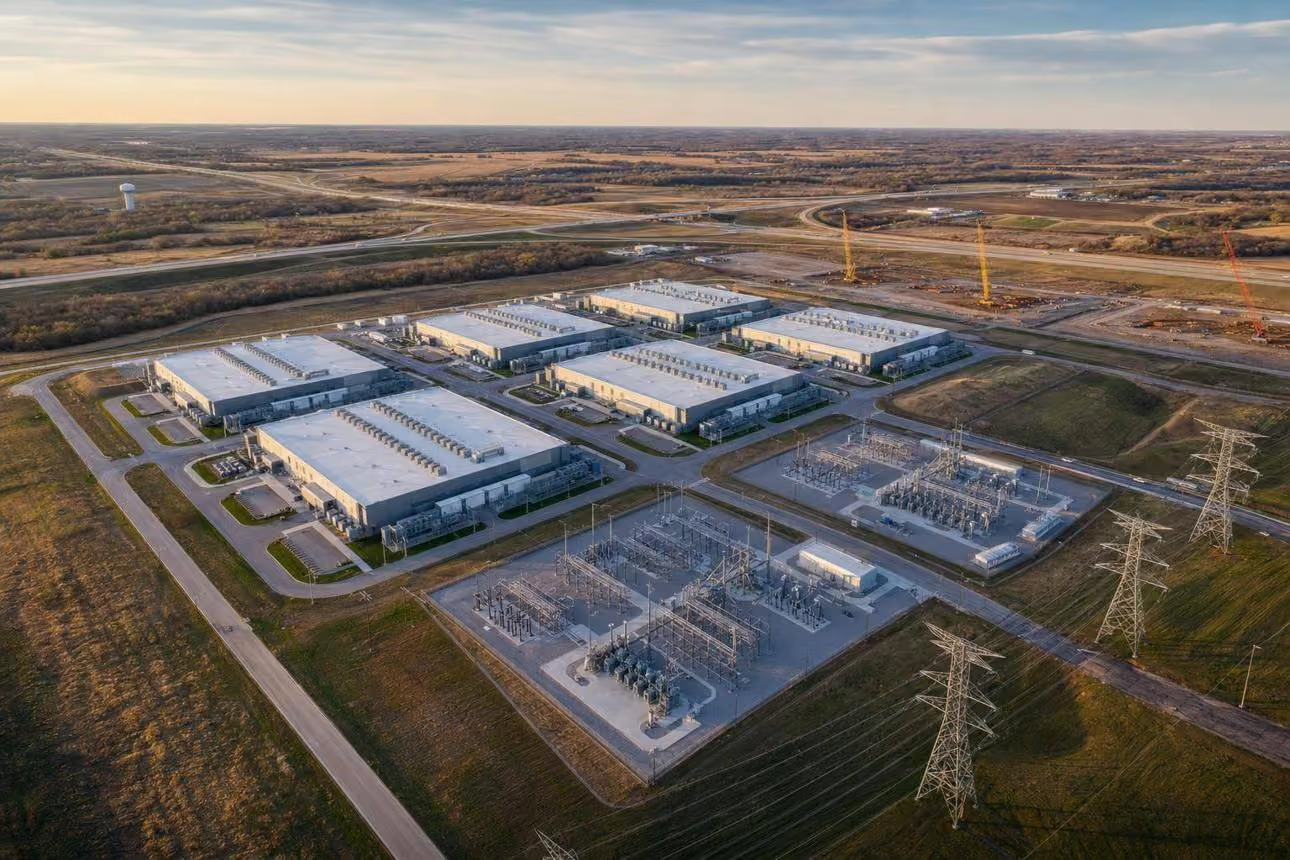
Large load developers and IPPs
See where capacity already exists before you commit to a site, and get value for the generation or storage you bring.
Why transmission planners trust ThinkLabs
“As California’s energy demands continue to increase, we need disruptive solutions to mitigate persistent challenges with current grid planning and operations. Innovative AI-driven power flow technology such as that developed by ThinkLabs, will be a key enabler for our grid digitalization efforts, supporting more efficient planning and operations for the feasibility, timeliness and affordability of the future grid.”
What transmission planners do with ThinkLabs

A physics-validated AI digital twin of your transmission network helps you:
- Validate the model every study depends on
- Locate headroom you already own
- Screen a request in minutes
- Credit what the customer brings
- Generate solutions to support load interconnect
Accelerate revenue from new load.
Results return in minutes, so large loads energize on your timeline rather than walking to a territory that can connect them sooner.
Defer capital you do not need to spend.
Generated solutions surface before a system upgrade becomes the default answer, and an upgrade that never gets built never enters rate base.
Scale planning throughput without scaling headcount.
Every planner clears more work, with full 8760 analysis behind each study instead of an approximation.
Lower the cost of the system you already have.
Additional load served from existing headroom spreads the network’s fixed costs over more revenue, easing the affordability case for the customers already on the system.
ThinkLabs transmission planning solutions
One product, one engine, one set of agents. The five use cases below are entry points into the same digital twin, not five separate purchases. Deployment runs in your own environment against your own data. Results are proven and validated against your existing network model outputs.
How the work moves through ThinkLabs
From the systems you already run to results your team can verify and defend.
Data integrated within your secure environment
Network model, measurement data, load and generation forecasts, and the interconnection set, ingested on premises from the systems you already run.
AI digital twin trained on premises
The AI digital twin trains on your network model and historical data.
The twin validated against physics
The AI digital twin’s output is checked against physics. Topology and load estimation rebuild what the model should say, deviations are flagged and corrected, and the case is verified to converge under power flow.
Agents do the work
8760 power flow and contingency analysis, capacity mining, interconnection impact, and topology optimization run across transmission at the speed and scale of AI.
Physics-validated solutions generated
Every violation comes with a mitigation option generated alongside it, turning what would have been a ‘no’ into a defensible ‘yes’.
Five specialized agents. One coordinated system.
Model validation and correction
Capacity mining
Automated interconnection studies
Flexible interconnection
Transmission expansion planning
See what a full year of network conditions does to the answer.
Multi-year time-series power flow
Generative mitigation options attached to every violation
Curtailable load valued in megawatts and hours across a full year of network states
Audit trail produced with the result, not assembled after it
Violations resolved by time, location, type, and magnitude
Bring-your-own-generation and customer storage credited at the point of interconnection
Non-convergence surfaced rather than hidden
Use case summary
Five entry points into one platform, ordered by how much capital each one commits.
1. Validate
2. Find
3. Assess
4. Structure
5. Build
Questions planners ask
You train once, then fine tune continuously to maintain integrity as your network changes. Training a transmission network model takes about 10 minutes and a few dollars of compute, so keeping the digital twin current is not a separate engagement, and there is nothing new for your team to manage.
On top of them. They stay your network model, and every ThinkLabs result is validated against them. The question is not which solver is better, it is how many scenarios your team can run inside a study window. Your classical solver will run any case you build. It will not build ten thousand of them, or run 8760 hours across a full network in minutes.
You verify it rather than trust it. Our results are deterministic and accuracy is reported against the physics solver rather than asserted, every result is checkable against power flow in your own environment, and when a case does not converge the system says so instead of returning a number anyway.
That is the most common answer and it is usually true, which is why model validation is the first use case rather than an assumption. Parameter errors and stale topology get found and corrected as part of the work. Model condition is an input, not a disqualifier.
So are we. ThinkLabs is physics-informed, and the AI digital twin is validated against the solver, not a substitute for it. The distinction that matters is whether you can run a multi-year time-series power flow across a full network and prove the result.
Regulators do not accept analysis they cannot audit, which is a different problem. Every result carries a record of what was evaluated, what bound, and why engineering holds. That record is usually stronger than what a manual study produces, because a manual study cannot show the alternatives it never had time to run.
No. Deployment runs in your own secure environment against your own data.
Then the analysis is the asset. Several states have moved toward requiring utilities to exhaust existing capacity before approving upgrades, toward direct cost assignment, and toward large loads covering the costs they cause. Each of those is a study output. A utility that can show it found existing headroom first, credited what the customer brought, and attached the remaining cost to the request that drove it is answering the affordability question with a record instead of an assertion.
A study on your own model, against a request your team has already run by hand, so the comparison is direct. Accuracy is reported against your solver and the result is checkable in your environment.
The rigor of power flow engineering
at the speed of AI.